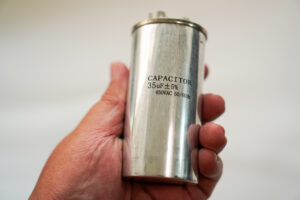
Ask any HVAC technician what they replace most often during an Antelope Valley July, and the answer is almost always the same: capacitors. It’s a component about the size of a soda can, it costs a fraction of what a compressor does, and it’s responsible for a huge share of the emergency calls that come in when temperatures climb past 105. Understanding why capacitors fail when they do, and what failure looks like before your system quits entirely, can save you a miserable afternoon without cooling.
What a Capacitor Actually Does
Your air conditioner has motors that need a strong jolt of electricity to get moving, and a steady push to keep running. The capacitor stores and delivers that electrical charge. Most residential systems have a dual-run capacitor that serves both the compressor and the outdoor fan motor.
Without a functioning capacitor, those motors either don’t start at all or struggle to keep turning. That’s why a failed capacitor takes down the entire cooling side of your system even though nothing else is broken.
Why July Is Peak Failure Season
Capacitors are sensitive to heat, and the Antelope Valley delivers plenty of it. Two factors combine in mid-summer:
- Ambient temperature. Your outdoor unit sits in direct sun, and internal temperatures inside the cabinet can run far above the already-high outdoor air temperature. Heat degrades the capacitor’s internal materials over time.
- Run time. In July your system may run 12 hours a day or more. Every start cycle draws on the capacitor, and long run times keep it hot for extended periods.
A capacitor that was marginal in May will often fail in July, because summer conditions expose weakness that mild weather hides. Most units last somewhere between five and fifteen years, but high-desert heat pushes them toward the shorter end of that range.
Warning Signs to Watch For
Capacitors rarely fail without any notice. Common signals include:
- A humming sound from the outdoor unit while the fan sits still
- The fan starting only after you nudge it, then running normally
- The system taking noticeably longer than usual to kick on
- Warm air coming from the vents while the outdoor unit appears to be running
- Higher energy bills without a change in your thermostat settings
- The breaker tripping when the AC tries to start
Any of these are worth a call to Econo West Heating Air & Plumbing before the part fails completely. Replacing a struggling capacitor is a short, inexpensive service visit. Waiting until it fails during a heat wave often means a longer wait for an appointment and, in some cases, additional damage to the motor it was supposed to protect.
Why You Shouldn’t Replace It Yourself
Capacitors are sold online, and there’s no shortage of videos suggesting this is a simple DIY fix. It isn’t. Capacitors hold a stored electrical charge even after the power is shut off, and that charge can cause serious injury. Beyond the safety issue, installing the wrong microfarad rating stresses your motors and shortens their life. A technician can discharge the unit safely, confirm the correct specification, and check whether something else caused the failure in the first place.
A Small Part Worth Checking
Capacitor testing is a standard part of any maintenance visit. A technician can measure whether it’s holding its rated charge and flag a weak one before it strands you. If your system has been showing any of the signs above, or you’d like a mid-season check before the next stretch of triple-digit days, call Econo West Heating Air & Plumbing at (661) 760-7411.